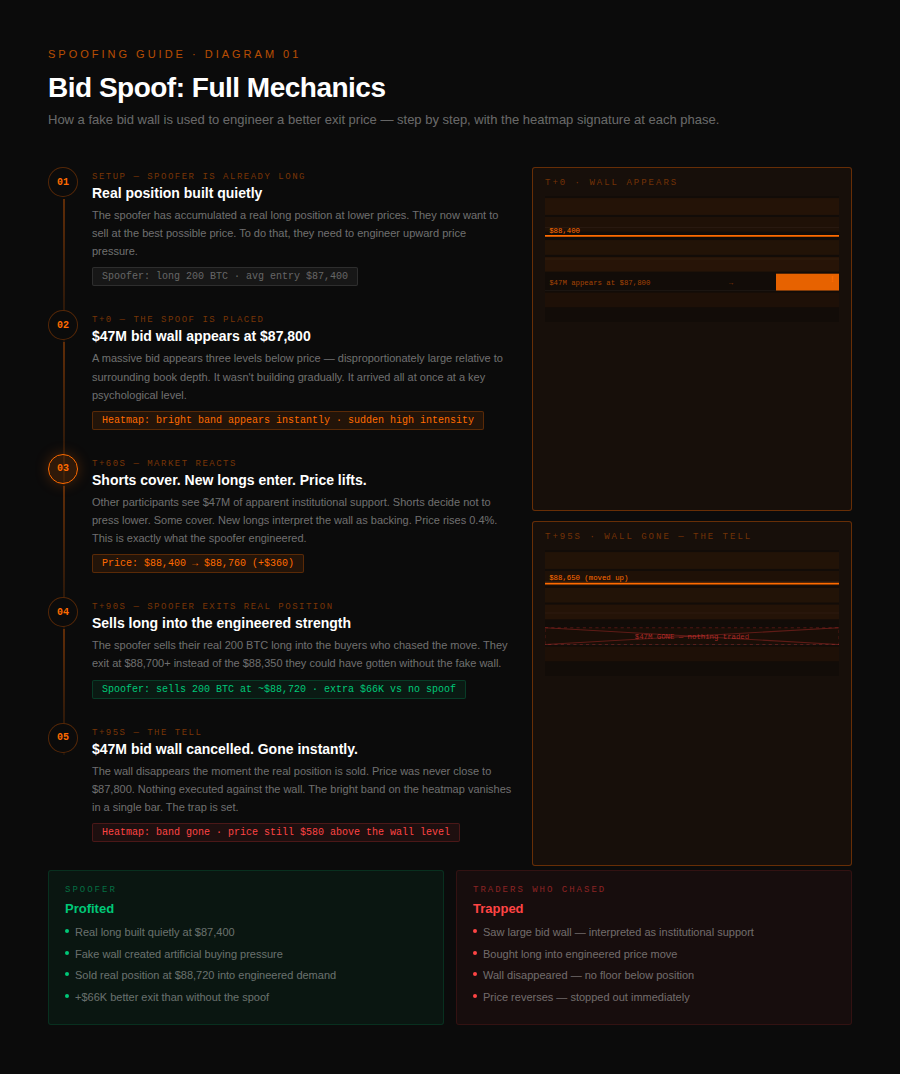
You're watching BTC consolidate at $88,400. Then a massive bid wall appears three levels below — $47M in resting orders at $87,800. The book looks defended. You hold your long, maybe even add. Price lifts slightly as shorts cover off the apparent support.
Ninety seconds later the bid wall is gone. Price is back at $88,200. The wall never traded — not a single contract executed against it. And the move it caused has already been monetized by the person who placed it.
You just got spoofed.
Understanding what happened — and how to see it coming on the QuantFlows heatmap — is the difference between reading the book and being read by it.
What Spoofing Actually Is
Spoofing is the practice of placing large limit orders with no intention of letting them execute. The order appears in the book, creates the impression of supply or demand at a key level, influences how other participants behave, and then gets pulled before price reaches it. The spoofer profits from the movement their fake order created.
It's illegal in regulated markets and has been prosecuted — most famously in the case of Navinder Sarao, a British trader whose spoofing activity contributed to the 2010 Flash Crash and earned him a criminal conviction. Paul Rotter, known as "The Flipper," built a reputation for placing enormous orders on the opposite side of his actual position to lure other traders in before reversing.
In crypto futures, where regulation is lighter and enforcement patchier than in equities, spoofing remains a live concern. The mechanics are identical: large order appears, price moves on sentiment, order cancels, spoofer exits into the move.
What makes spoofing detectable is that it leaves a specific visual signature on the order book over time — a signature the QuantFlows heatmap makes visible in real time.
The Two Core Spoof Setups
Spoofing works in both directions, but the mechanics follow the same structure.
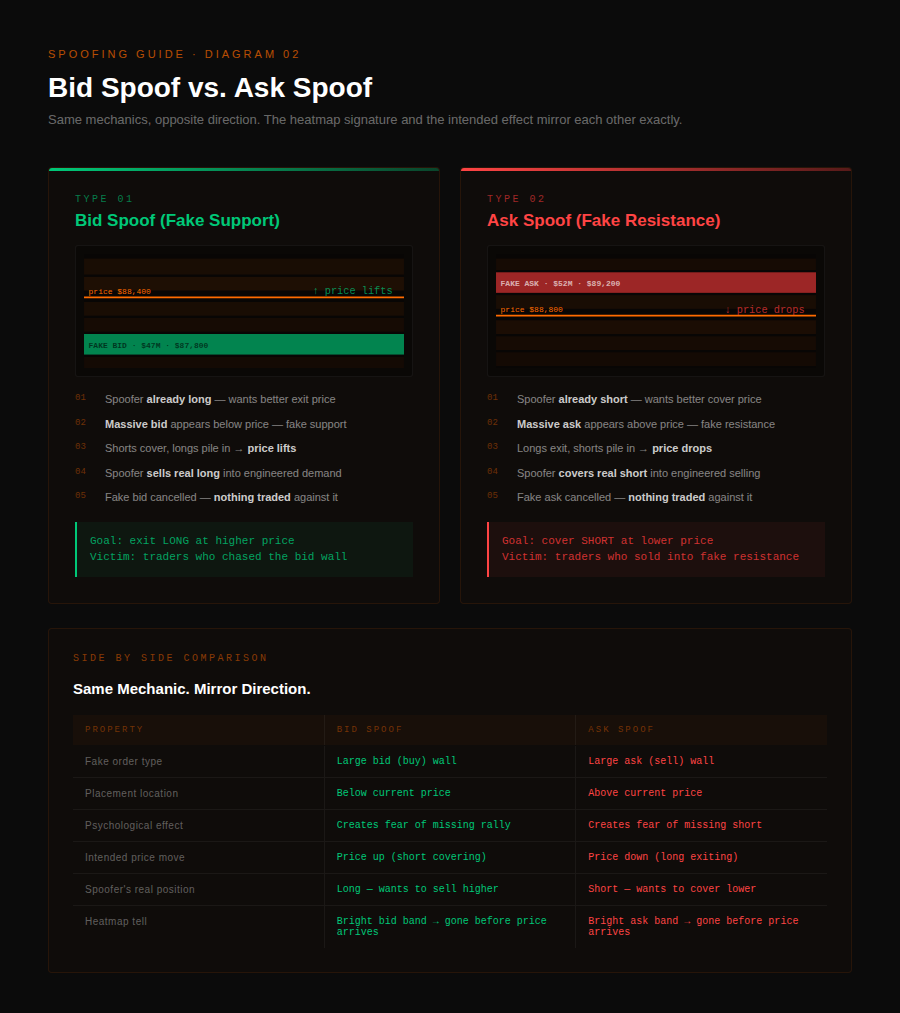
- Bid spoofing — creating false buying interest. A large bid wall appears below current price. The immediate effect: shorts are reluctant to press lower into apparent support. Some shorts cover, adding mechanical buying pressure. New longs enter, interpreting the wall as institutional backing. Price ticks up. The spoofer, who was long before placing the fake bid, sells into this engineered strength at a better price than they could have otherwise. The bid wall disappears. Nothing executed against it.
- Ask spoofing — creating false selling pressure. A large offer appears above current price. Longs hesitate to push through apparent resistance. Some longs exit, creating selling pressure. The spoofer, who was short before placing the fake offer, covers into this engineered weakness at a better price. The ask wall disappears. Nothing traded against it.
In both cases, the spoofer uses their fake order as a tool to improve their exit price on a real position they already hold. The fake order is the mechanism; the real trade is what they're actually doing.
The Visual Signature on the Heatmap
This is where QuantFlows gives you a concrete edge over traders working from candle charts alone. Spoofing leaves a specific pattern that the heatmap makes legible.
- Sudden appearance at a key level. Real liquidity accumulates over time — you see it building gradually as participants place and adjust orders. A spoof order arrives all at once, fully formed, at a psychologically significant level. On the heatmap, this looks like a new band of high intensity appearing in a single bar where nothing meaningful existed moments before. The suddenness is the first flag.
- Disproportionate size relative to surrounding book. A spoof order typically needs to be large enough to be visible and influential — it needs to register as meaningful support or resistance to other participants. Compare the size of the wall to the surrounding depth. If the wall is five to ten times the size of adjacent levels, the disproportion itself is a signal. Real institutions building positions usually spread size across levels; spoofers concentrate it for maximum visual impact.
- Disappearance before price contact. This is the definitive tell. On the QuantFlows heatmap, you can watch a wall's intensity over time. Real liquidity that defends a level shrinks gradually as orders execute against it — the color dims slowly as size gets absorbed. A spoof order vanishes all at once, while price is still several levels away. The band goes from bright to invisible in a single bar. Nothing traded. Nobody executed against it. It simply left.
The Algo Spoof Pattern
A second, more sophisticated spoofing pattern appears in crypto futures and has a distinct signature from the single-wall spoof.
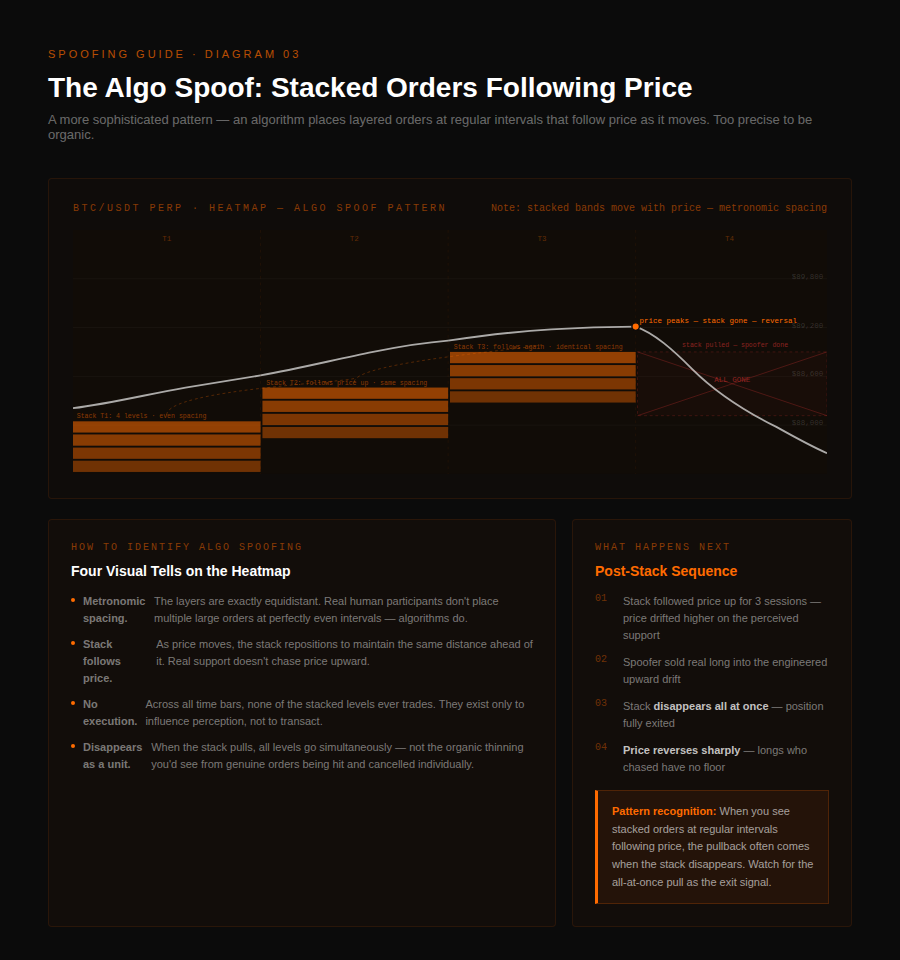
Instead of one large order at a fixed level, an algorithm places a series of large orders stacked at regular intervals across multiple price levels, and moves them in sync with price as it travels. The stack follows price — always staying a fixed distance ahead of the current level, always appearing to offer support or resistance just beyond where price is trading.
On the heatmap, this looks like a moving band of intensity that tracks price from a distance — never getting closer, never executing, reforming after each price move at the same interval. It's too regular to be organic. Real participants don't systematically rebuild their entire position at identical distances as price moves; this precision is algorithmic.
When you see stacked orders following price at metronomic intervals, the likely outcome is a pullback after the algo closes its real position. Watch for the stack to disappear and price to retrace shortly after.
How to Trade Around Spoofing — What QuantFlows Shows You
The goal isn't to trade against spoofers — that's a dangerous game with no reliable edge. The goal is to avoid being influenced by fake liquidity and to recognize when price movement is being artificially engineered.
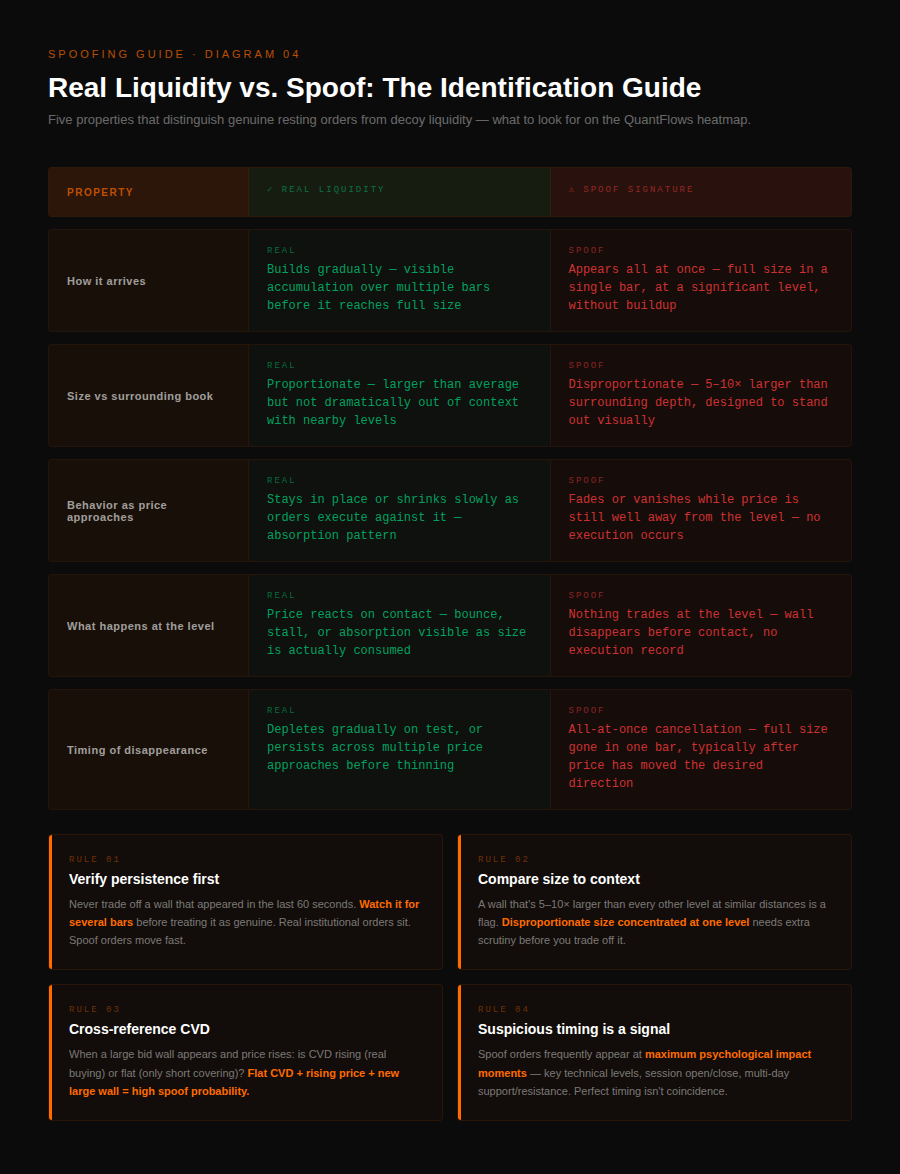
- Rule one: verify persistence before acting on a wall. In QuantFlows, watch the wall for a minimum of several bars before treating it as genuine support or resistance. Real liquidity sits. Spoof liquidity moves fast. A wall that's been in the book for ten minutes and is visibly being tested without disappearing is a fundamentally different proposition from one that appeared forty seconds ago.
- Rule two: watch whether price actually reaches the wall. The most reliable spoof confirmation comes after the fact — the wall disappears while price is still distant. If you see this pattern on the QuantFlows heatmap, note it. That level was not what it appeared to be. Price moved because of the wall's psychological influence, not because real buyers were there. Don't expect that level to function as support on the next test.
- Rule three: cross-reference with CVD. When a large bid wall appears, watch CVD simultaneously. If CVD is falling — aggressive sell flow coming in — while price is holding above the wall, the wall might be absorbing real pressure. If CVD is flat or rising, the price move is being driven by shorts covering off the psychological impact of the wall. Flat CVD + large wall + price lifting = high probability spoof environment.
- Rule four: be suspicious of perfect timing. Spoof orders frequently appear at moments of maximum psychological impact — exactly at a key technical level, exactly at the session open or close, exactly as price is testing multi-day support. Real institutional orders don't require perfect timing for theatrical effect. When a huge wall appears at the exact level everyone is watching at the exact moment it matters most, skepticism is warranted.
What This Means for Your Trades
Spoofing matters to the average futures trader in one specific way: it creates false signals at levels you might otherwise trade with confidence.
If you're using order book depth as part of your entry logic — watching for support walls before buying — a spoof bid can pull you into a long that has no floor. The wall disappears as price tests it and you're immediately underwater with no structural reason to hold.
The protection isn't a rule. It's a read. QuantFlows' heatmap gives you the time-series view of the book that makes decoy liquidity visible. Wall appears suddenly at a key level, large relative to surroundings, disappears before price contact: that's the pattern. Once you can recognize it, you stop being the trader who chases the engineered move and start being the one who watches it from the sideline and trades the reversal when the spoof exhausts itself.
The book doesn't lie. But some of what's in it is designed to make you lie to yourself.
QuantFlows is free during beta. Access the real-time heatmap, CVD, liquidation clusters, and Bubble Market Dots across Binance, Bybit, OKX, and Hyperliquid at quantflows.xyz.