Most retail traders know institutions exist. Fewer understand what that actually means for how the market moves — and almost none think about how to use institutional activity as a signal rather than a threat.
The narrative is usually framed as a war retail traders are losing. That framing misses the point. Institutions aren't trying to stop you from making money. They're managing billions across mandated strategies, constrained by size, regulation, and execution risk in ways retail traders never are. Understanding those constraints is what turns the gap from a disadvantage into an edge.
What Institutions Actually Are — and What They're Doing
Institutional traders isn't a single category. It encompasses hedge funds, proprietary trading firms, pension funds, market makers, CTA funds, and increasingly — since the SEC approved Bitcoin spot ETFs in January 2024 — large asset managers running regulated crypto products. Institutional participation deepened Bitcoin's order books considerably after 2024, and the nature of crypto market structure shifted with it.
What unifies institutional participants is that they manage capital on behalf of others, operate under regulatory constraints, and execute orders large enough to move markets. A hedge fund buying $200M of BTC perp on Binance cannot simply place a market order. The market impact would be immediate and severe — their own buying would push price against them before the order completes.
Institutions often execute over time and employ sophisticated strategies to mask their activities. TWAP algorithms (time-weighted average price), iceberg orders, dark pool execution, OTC desk trades — all designed to enter or exit large positions without telegraphing their intent to the market.
This is the first thing retail traders misunderstand: institutional size is a constraint, not an advantage. The constraint creates footprints.
The Three Gaps That Actually Matter
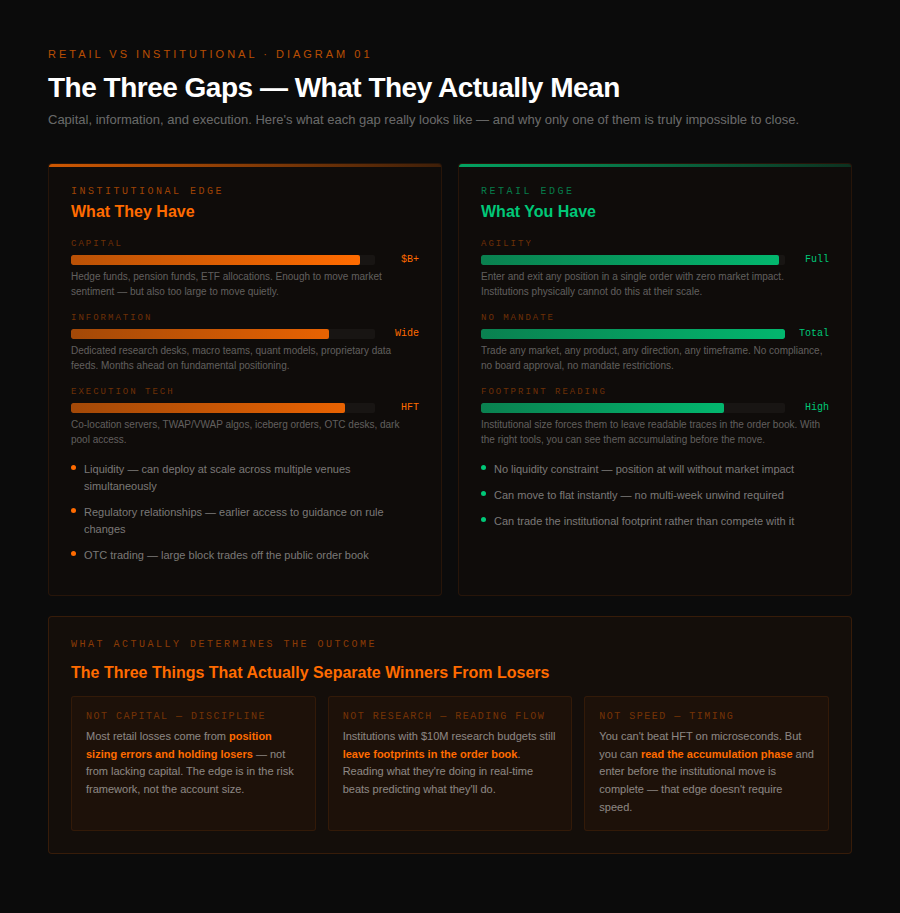
Capital. Institutions have more of it — dramatically more. A hedge fund running $2B in crypto exposure has leverage over market sentiment that a retail account never will. They can sustain positions through drawdowns, absorb volatility, and wait for thesis confirmation in a way most retail participants cannot.
But capital at scale creates the liquidity problem. Institutions are like elephants. It takes them a while to unload or buy millions of contracts. It is harder for them to put up huge numbers in returns in a short period of time. A position large enough to matter takes weeks or months to build — creating a sustained, directional signal in the order book that retail traders can observe.
- Information. Institutional research desks have teams running macro analysis, quantitative models, and proprietary data feeds — sentiment analysis from satellite imagery, credit card data, web traffic metrics — that no individual trader accesses. Professional firms engage in statistical arbitrage — systematic strategies that exploit pricing inefficiencies and predict future price moves from statistical patterns.
The information gap is real. But in crypto futures, a significant portion of institutional edge comes from reading order flow — the same data that's visible to any trader watching the right tools. The difference isn't always information quality; it's information processing speed and the discipline to act on it. - Execution. Liquidity on platforms like Binance peaks at 11:00 UTC and declines by 42% by 21:00 UTC, creating predictable windows for institutions and algorithms to execute large orders with minimal price impact, while retail traders face higher slippage during low-liquidity periods. Institutional algorithms are designed to find these windows and exploit them. Retail traders entering at the wrong time of day are consistently paying more for the same exposure.
Why Institutional Size Creates the Signal Retail Can Read
Here's what most traders miss: the bigger the position, the harder it is to hide.
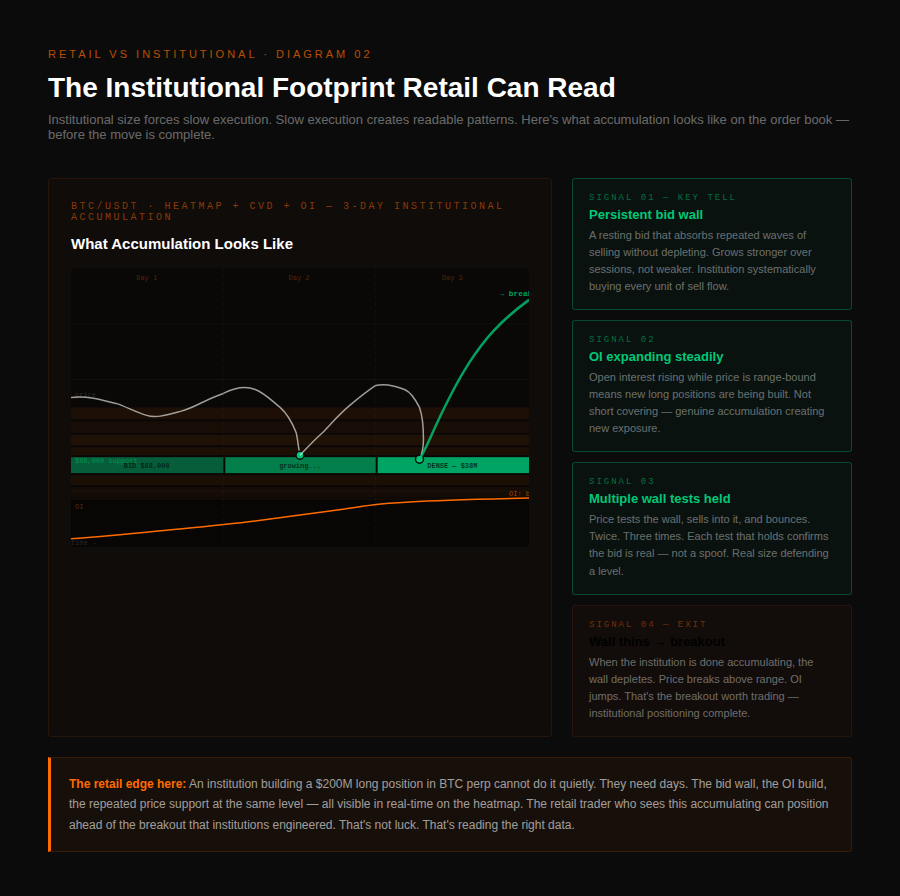
An institution accumulating a long position in BTC cannot do it in a single order without moving price against itself. It must spread execution across time — using limit orders that sit in the book, TWAP algorithms that break the position into smaller pieces, and iceberg orders that show only a fraction of their true size while the rest queues behind. All of this leaves traces.
In the order book, sustained accumulation looks like a resting bid that absorbs repeated waves of selling without depleting. Price tests a level, sellers hit the bid, and the level holds — not because of random noise, but because a large participant is systematically buying every unit of sell flow. This is absorption, and it precedes institutional-scale directional moves consistently enough to be one of the most reliable signals in order flow trading.
Distribution — the process of an institution exiting a large long — looks equally distinct. As smart money sells into retail buying, ask walls appear and hold at key levels. CVD diverges from price. Volume is high but price progress stalls. The institution is offloading into every wave of retail buying until their position is clear.
Institutional order flow appears to take advantage of liquidity changes, jumping in when spreads narrow, while retail order flow does not. This discipline — waiting for the right liquidity conditions, using limit orders rather than market orders, masking size through iceberg structures — is exactly what creates the patterns visible on a heatmap.
The institutional footprint isn't hidden. It's just expressed in a language that requires the right tool to read.
What Retail Actually Has That Institutions Don't
The disadvantage narrative ignores three genuine retail advantages that compound significantly for an active futures trader.
- No liquidity constraint. A retail trader can enter and exit a position in a single order at market price with zero market impact. This sounds trivial. It's not. An institution that wants to exit $500M of BTC exposure has to manage that unwind over days or weeks to avoid moving the market against themselves. A retail trader can close a position in a second and move to an entirely different setup. This agility — the ability to be completely flat and reposition without consequence — is something no institutional fund can replicate.
- No mandate. Institutional funds operate under investment mandates that constrain what they can trade, how much leverage they can use, and what risk metrics they must maintain. An index ETF must hold its index components regardless of whether those components are good trades. A macro fund with a mandate to stay net long cannot simply go short when the cycle turns. A retail trader can short when they want, go flat when they want, trade any market, any product, any timeframe — without answering to a compliance department or a board.
- Reading the footprint. The irony of the institutional advantage is that it creates the signal retail traders need to find better entries. An institution accumulating can't hide from a sustained bid wall on the heatmap. An institution distributing can't hide CVD divergence. The size that gives them market impact is the same size that makes their activity legible to anyone watching the right data.
Retail strategies like limit orders and liquidity cycle monitoring can mitigate costs by 20 basis points, but behavioral biases and social media hype often undermine effectiveness. The edge available to retail isn't in competing with institutional information or speed. It's in reading what institutions are doing at the structural level — and positioning alongside their accumulation rather than against their distribution.
The Correct Frame
Retail traders don't lose because institutions are smarter. They lose because they trade reactively — chasing price moves that institutions manufactured, buying breakouts that institutions are using to distribute, and selling into support that institutions are using to accumulate.
The shift is simple in theory and hard in practice: stop asking what price is doing and start asking what participants are doing. A breakout is only worth trading if the order flow underneath it shows real commitment — expanding open interest, CVD confirmation, resting bids holding on the retest. A sell-off is only worth fading if absorption is visible — a bid wall holding through multiple waves of selling, CVD flattening, OI declining rather than expanding.
The institutional footprint is the most reliable signal in the market. It just requires the right lens to read it.
QuantFlows tracks real-time heatmap, CVD, open interest, and liquidation clusters across Binance, Bybit, OKX, and Hyperliquid — giving retail traders the order flow layer to read institutional footprints as they form. Free during beta at quantflows.xyz.