You're watching BTC consolidate at $88,600. The order book looks chaotic — hundreds of orders appearing and vanishing across multiple levels simultaneously, faster than anything a human could place. Price stutters. Your limit order confirmation takes longer than normal. By the time execution clears, the price you wanted is gone.
You weren't unlucky. You were in the middle of a quote stuffing episode.
Unlike spoofing — which uses fake orders to create a directional impression — quote stuffing isn't trying to fool you about where price is going. It's trying to slow you down. The goal is to overwhelm the exchange's order processing system, create execution delays for competing traders, and carve out a timing advantage that lasts only milliseconds. But milliseconds are everything when you're an algorithm.
What Quote Stuffing Actually Is
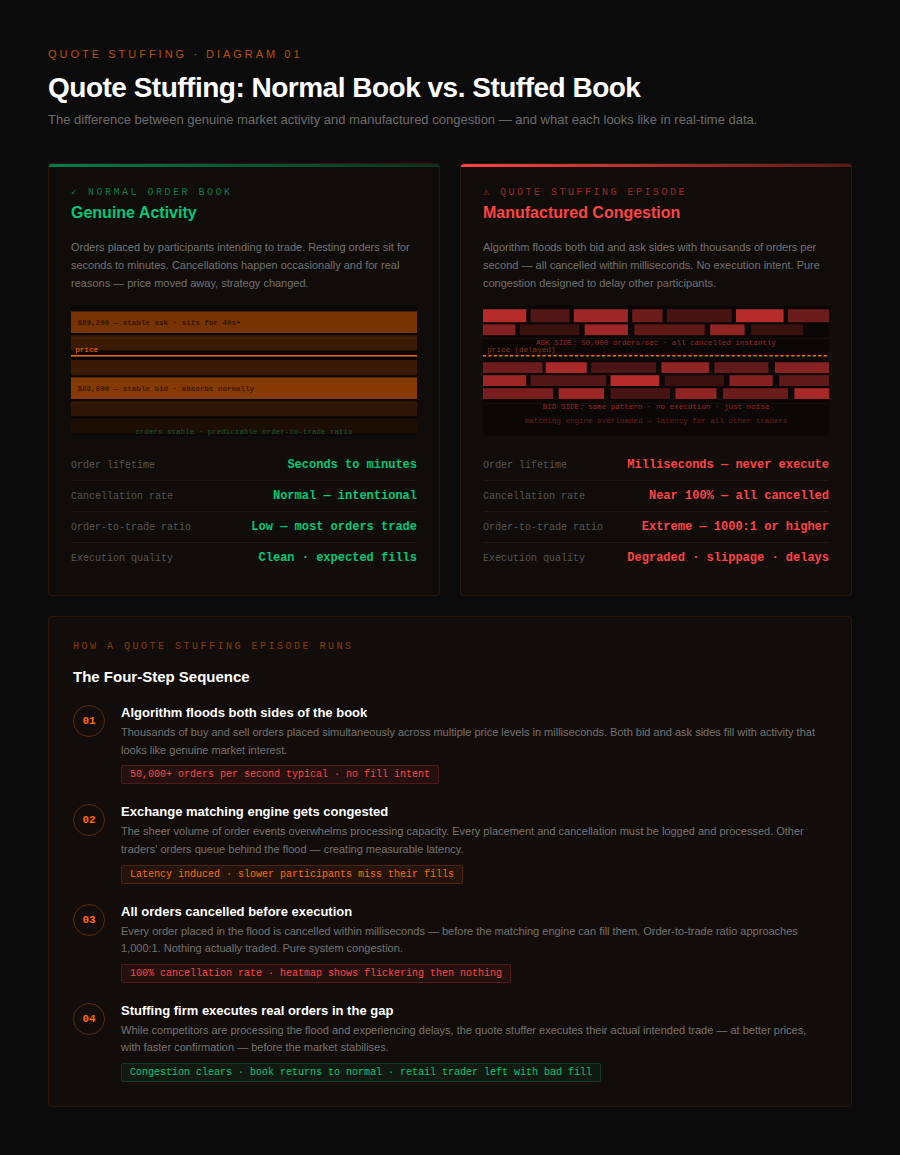
Quote stuffing is the practice of flooding the market with an extremely high volume of orders — often thousands per second — and canceling them almost immediately. Not to build a position. Not to create a directional impression. Purely to congest the order book and delay order processing for everyone else.
The term was coined by market data firm Nanex during their analysis of the May 6, 2010 Flash Crash, when the Dow Jones Industrial Average dropped nearly 1,000 points in minutes and the NYSE recorded $4.1 billion in losses within 36 minutes. Their research found that certain stocks were receiving hundreds of quote updates per second — far beyond any legitimate trading purpose — right before the crash accelerated.
The mechanics are straightforward: an HFT algorithm submits buy and sell orders across multiple price levels in rapid succession, then cancels all of them before they execute. The exchange's matching engine has to process every placement and every cancellation. That processing load creates latency — tiny delays that compound across the order book. Slower participants find their order confirmations taking longer, their fills arriving at worse prices, or their limit orders missing the intended level entirely.
The perpetrators of this tactic aren't trying to trade — they're trying to make it harder for everyone else to trade cleanly while they exploit the resulting confusion.
How It Differs From Spoofing and Layering
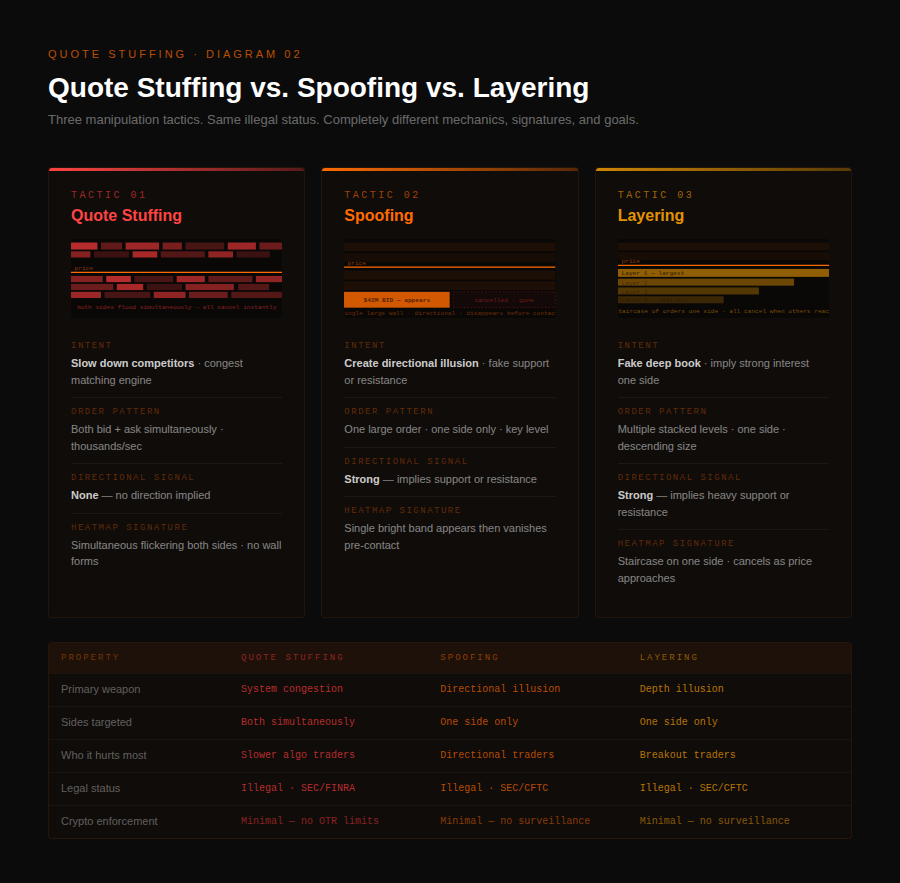
These three tactics share a common thread — all involve orders that aren't genuinely intended to execute — but each operates differently and serves a different purpose.
Spoofing places one large order at a key level to create a directional illusion. A single $40M bid appears below price to discourage selling. It disappears before price arrives. The intent is psychological: change what other traders believe about supply and demand.
Layering places multiple orders at staggered price levels on one side of the book to create the appearance of deep, genuine interest. The layers make the book look heavily skewed in one direction. When other traders react, the layers get cancelled. The intent is structural: distort the visible depth of the book.
Quote stuffing doesn't care about direction or perceived depth. It floods both sides — bids and asks — with high-frequency order placements and cancellations simultaneously. The intent is mechanical: congest the system, generate latency, slow down competitors, and exploit the brief information edge that creates.
The visible signature is different too. Spoofing shows up as a sudden large wall that appears then disappears. Layering shows up as a staircase of orders on one side. Quote stuffing shows up as a burst of flickering activity across many levels simultaneously — orders appearing and vanishing so fast they're almost imperceptible in normal viewing, but visible as rapid intensity fluctuations on a heatmap.
The Flash Crash Connection — and Why Crypto Is More Exposed
The 2010 Flash Crash remains the most documented case of quote stuffing at scale. Navinder Sarao — the British trader later convicted for market manipulation — used a combination of spoofing and quote stuffing in the E-mini S&P 500 futures market. His algorithm placed and cancelled thousands of orders in rapid succession to create artificial market congestion, which contributed to the liquidity evaporation that turned a sharp sell-off into a historic crash.
Since then, regulated markets have fought back. The SEC's MIDAS surveillance system processes over a trillion market events daily. CME's Aurora system flags suspicious order patterns in real time. Major exchanges have introduced order-to-trade ratios — penalties for cancelling too high a proportion of placed orders — which disincentivize the tactic. Speed bumps of 300-350 microseconds on some venues reduced quote stuffing effectiveness significantly between 2015 and 2023.
Crypto futures markets are less protected. Binance, Bybit, OKX, and Hyperliquid don't publicly disclose their surveillance methods or order-to-trade thresholds. There's no equivalent to MIDAS watching crypto order books. Regulation is lighter. The result: quote stuffing remains viable in crypto markets in a way it's been largely squeezed out of regulated equity and futures venues.
This matters for the retail futures trader because execution quality during quote stuffing episodes is genuinely degraded. Market orders fill at worse prices. Limit orders miss their intended levels. The book looks active when it's actually artificially congested.
What It Looks Like on the Heatmap — and What to Do
The heatmap signature of a quote stuffing episode is distinct from normal activity and from spoofing. Instead of one large wall appearing and disappearing, you see rapid intensity flickering across multiple levels on both sides simultaneously. Bands appear, brighten, and vanish faster than normal order book dynamics — in normal trading, resting orders sit for seconds or minutes; in a quote stuffing burst, they cycle in fractions of a second.
Practically, the heatmap helps you identify these windows so you can manage around them rather than trade into them:
When you see simultaneous flickering on both bid and ask sides across multiple levels — not a directional move, not absorption, not a single wall — that's your signal to pause. The book is congested. Your execution quality for the next 10-30 seconds is degraded. A limit order placed into that environment may not fill where you intend.
The correct response is neither to panic nor to chase. Quote stuffing episodes are typically brief. The congestion clears. When it does, watch whether real directional flow emerges from underneath it — large resting orders building on one side, CVD trending — or whether price simply returns to where it was before the noise hit.
Most retail traders interpret quote stuffing as volatility and either freeze or react impulsively. Both responses are what the tactic is designed to produce. Recognizing it for what it is — manufactured congestion with no directional content — keeps you from making decisions inside a distorted window.
QuantFlows visualizes the real-time order book across Binance, Bybit, OKX, and Hyperliquid — letting you see quote stuffing episodes, spoofing patterns, and genuine liquidity in a single heatmap view. Free during beta at quantflows.xyz.