Most Traders Click "Buy" Without Knowing What They Just Did
Every trade you've ever made started with an order. You picked a direction, sized your position, and hit the button. But between that click and your fill, something specific happened in the market — and if you don't understand what, you're trading with a blindfold on.
Market orders and limit orders aren't just two ways to enter a trade. They're two completely different instructions with different guarantees, different tradeoffs, and different effects on the market around them. Understanding how they work — and how they interact — is the foundation of reading price action at the level serious traders operate.
What Is a Market Order?
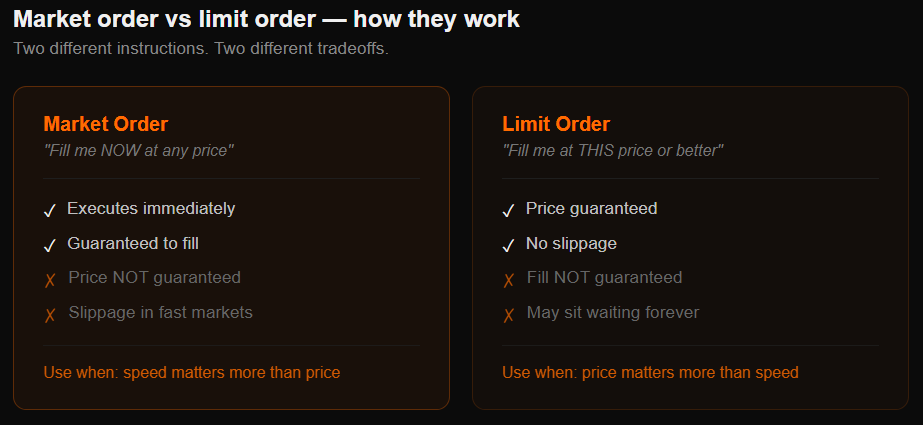
A market order is the most direct instruction you can give the exchange: fill this trade immediately at whatever price is currently available.
There are only two parameters: direction (buy or sell) and size. No price condition. The exchange matches your order against the best available resting orders on the opposite side and executes.
What you get: Immediate execution. Guaranteed fill.
What you give up: Price certainty. In a fast-moving market, the price you see when you click and the price you actually get filled at can be very different. That gap is called slippage — and in high-volatility moments, it can eat significantly into a trade.
A market buy order says: I want in so badly right now that I'll pay whatever the sellers are asking.
That urgency has a cost.
What Is a Limit Order?
A limit order adds one critical parameter to the instruction: a specific price.
A buy limit order says: fill me at this price or lower — but don't fill me at anything worse. A sell limit order says: fill me at this price or higher.
What you get: Price certainty. You will never be filled at a worse price than your limit.
What you give up: Execution certainty. If the market never reaches your limit price — or if it touches it briefly but your order doesn't get matched in time — you don't get filled. The trade doesn't happen.
A limit order is patient. It sits in the order book and waits. And this is where things get interesting.
The Order Book: Where Limit Orders Live
Every limit order that hasn't been filled yet sits in something called the order book — a live, real-time record of all outstanding buy and sell instructions.
The order book has two sides:
- The bid side — all resting buy limit orders, stacked below current price. Buyers waiting.
- The ask side — all resting sell limit orders, stacked above current price. Sellers waiting.
The gap between the highest bid and the lowest ask is the spread. In a liquid market (BTC, ETH perps on Binance), the spread is tiny — a dollar or two. In thin markets or during volatility, it widens fast.
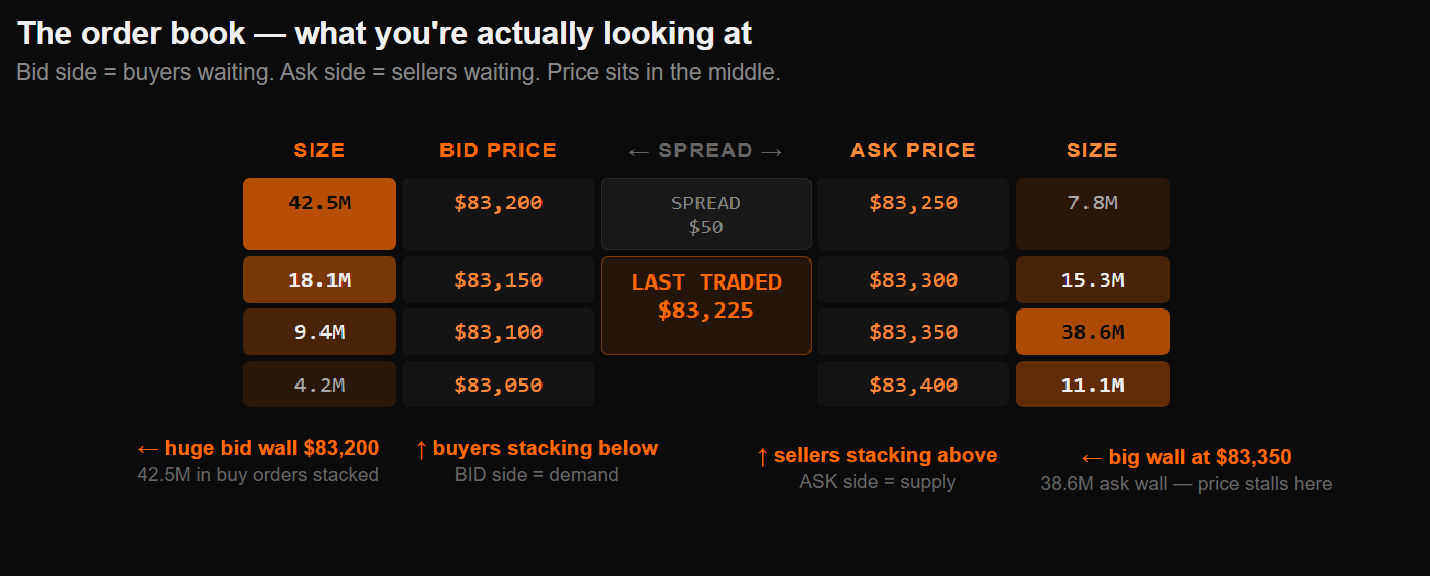
Here's the key insight: the order book is liquidity. All those stacked limit orders are the market's fuel. They're why your market order can fill instantly. They're also why some price levels hold and some don't.
How Market Orders Actually Move Price
This is where most traders' understanding breaks down.
Price doesn't move because of "sentiment" or "momentum" or a chart pattern. Price moves when aggressive market orders eat through resting limit orders faster than new ones can appear.
When a large market buy order fires, it doesn't fill at one price — it sweeps upward through the ask side of the book, consuming limit sell orders level by level until the market order is fully filled. Each level consumed pushes the price higher.
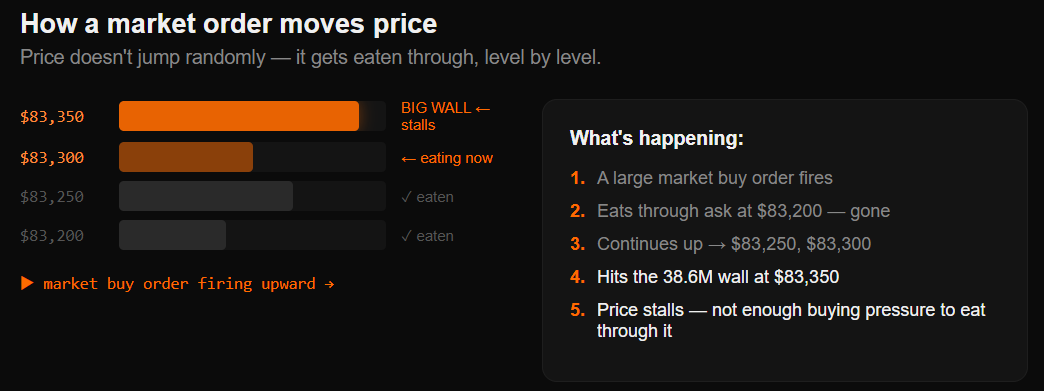
This has two critical implications:
First: Large concentrated clusters of limit orders act as walls. If there's $40M sitting on the ask at a single price level, a market buy order needs to bring $40M worth of buying pressure just to push through that one level. Until it can, price stalls there.
Second: When those walls disappear — either absorbed by sustained buying pressure or pulled by whoever placed them — price moves fast. There's nothing left to absorb the aggression. These gaps in the book are sometimes called air pockets, and they explain why price sometimes doesn't walk through a level, it teleports.
Stop Orders: The Third Type
A stop order adds a conditional trigger to the instruction: don't execute this until price reaches a specified level, then execute as a market order.
Stop orders are most commonly used as stop-losses — a protective mechanism to exit a position if price moves against you. A sell-stop placed below your long entry will trigger as a market order if price falls to that level.
The important thing to understand: a triggered stop becomes a market order. It inherits all the guarantees and drawbacks of market orders — guaranteed fill, uncertain price. In a fast market, your stop triggering at $83,000 might fill at $82,850.
This matters for sizing your risk.
What Order Book Depth Tells You That Candles Don't
A standard candlestick chart shows you what already happened — the open, close, high, and low of a time period. By the time you see it, it's history.
The order book shows you what's waiting to happen.
When you can see that there's $45M stacked on the bid at a specific level, you're not predicting where price will go — you're reading where buying pressure is concentrated before price gets there. When price approaches that level, you already know what's waiting on the other side.
This distinction changes how you trade entries. Instead of asking "is this a support level based on where price bounced before?" you start asking "is there actual liquidity defending this level right now?"
Order book depth — the measure of how much liquidity exists at each price level — gives you that answer in real time.
A deep book with large orders at each level means price is stable and hard to move. A thin book means even moderate order flow can cause significant price movement. Knowing which environment you're in before you enter changes your position sizing, your stop placement, and your expectations.
Practical Implications for Your Trades
On entries: A market order into a fast-moving market guarantees you're in the trade — but possibly at a price that immediately puts you offside. A limit order gives you the price you want but risks missing the move entirely. Neither is universally right. The right choice depends on how urgently the opportunity needs to be taken.
On stop placement: Stops placed at "obvious" technical levels are also obvious to everyone else. They become a cluster of resting sell orders that large players can target. Understanding where stops are concentrated — and how price behaves when it approaches that liquidity — is the difference between a stop that protects you and one that gets you shaken out of a valid trade.
On reading levels: The next time you look at a "support" level on a chart, ask the deeper question: is there actual buying pressure in the order book defending that level right now? Or is it just a historical candle pattern with no live orders behind it? One holds. The other doesn't.
The Edge Hidden in the Order Book
Most retail traders operate on the surface layer — candlestick charts, indicators, pattern recognition. These tools work with historical data. They show you what happened.
The order book is the underlying reality those candles summarize. Every move, every bounce, every fake breakout has an explanation in the book. A wall that absorbed buying pressure. A bid cluster that defended a level. A sweep of stops that triggered a cascade. None of this is random — it's mechanics.
Learning to read the order book doesn't give you a crystal ball. But it gives you something more valuable: a way to ask better questions about what the market is actually doing, moment to moment, before price tells you.
That's where the real edge lives.
QuantFlows visualizes the live order book in real time — bid walls, ask clusters, absorption events, and liquidity sweeps — across Binance, Bybit, OKX, and Hyperliquid simultaneously.